

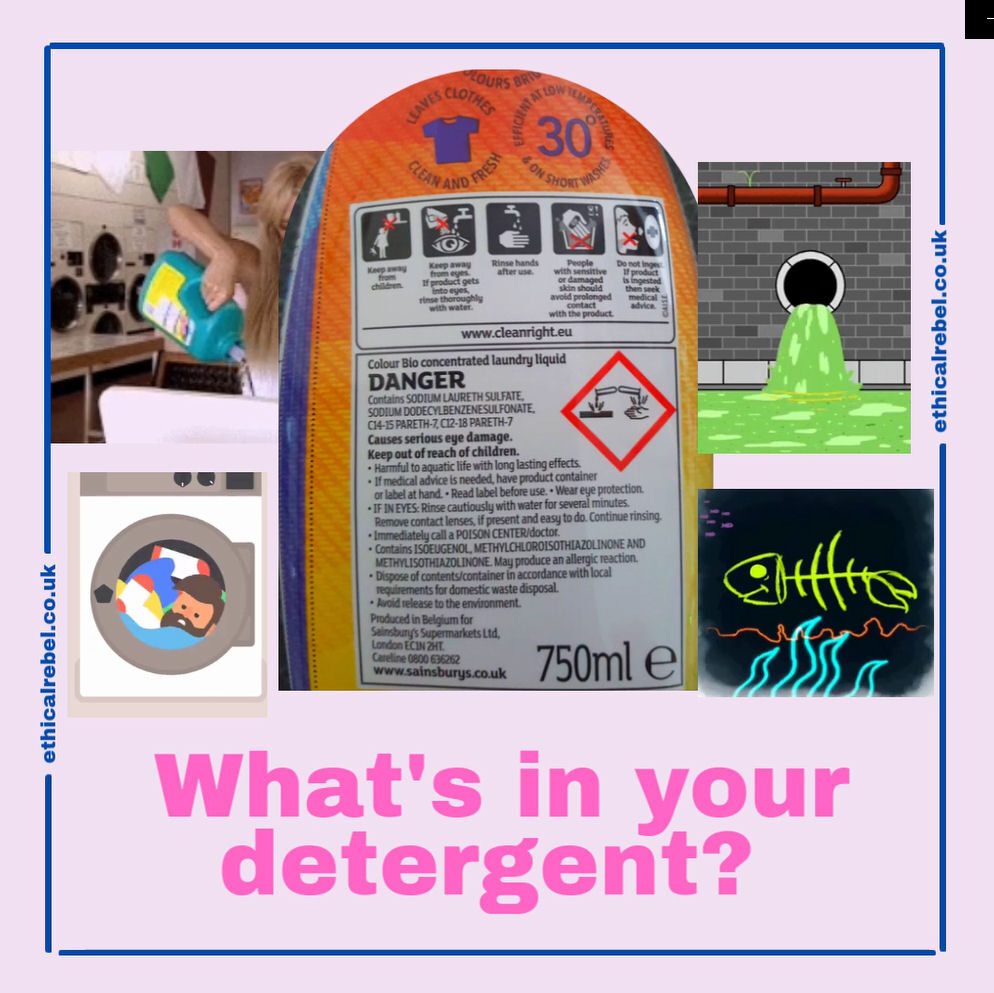
Do you know what’s in your detergent? It seems a simple enough question, but how many of us actually check the ingredients on the back of the washing detergent bottles we buy? And why would we need to? The label on the bottle in the main image is surprisingly transparent about the harm it causes. But many are not. Liquid detergents can contain more harmful chemicals and plastics than they list, because detergent companies are not required to include them on the product label, (though they must publish them on their website and reference the website address on product packaging). Most detergents contain ingredients that are harmful to aquatic life. And while they may be diluted when they get washed away in the washing machine waste water, they accumulate as millions of households use these ingredients daily. This label includes the caution ‘Avoid release to the environment.’ But that’s exactly where they end up. These toxins do not biodegrade but pass through sewage treatment works and end up in our rivers and seas. In addition, if the right microbes are not introduced in sewage treatment plants, they leave chemical traces behind which do not fully dissolve.
What are these chemicals?
Detergent companies tend to respond slowly to demands for eco-friendly detergents.
In 1965, they began producing “bio-degradable” products to eliminate a major pollutant which left a residual foam on rivers. Around this time, scientists also reported that other detergent ingredients, known as phosphates, remained in wastewater despite treatments. These made their way into natural waterways where they caused nutrient pollution and fed algae. This led to eutrophication which, combined with the harmful algal bloom, stopped light and oxygen getting into the water. The result was the death of organisms in the aquatic ecosystem.
Despite the evidence, many laundry detergent brands didn’t just keep the phospates in their detergents, but increased them. The UK government finally banned them in 2017.
But many detergents still contain harmful chemicals:
- quaternium-15 (known to release carcinogenic formaldehyde),
- diethanolamine (linked to skin and eye irritation and possibly liver problems),
- nonylphenol ethoxylate or NPE (toxic to nerves, irritating to skin, potential hormone disruptor, toxic to aquatic life),
- linear alkyl benzene sulfonates or LAS (irritates skin and eyes and toxic to aquatic life; benzene is a carcinogen);
- bleach (which can form toxic organic compounds that have been linked with respiratory issues, liver, and kidney damage),
- 1,4-Dioxane, (EPA classified as a Group B2, probable human carcinogen) and
- brighteners – chemicals that remain on clothes to absorb UV light and help clothes “appear” brighter (may cause irritation, decompose relatively slowly and can be toxic to marine life).
Most of these chemicals are harmful to the environment, our health and the health of other animals. They remain in your clothes and when they become damp or wet, for example when you sweat, your body absorbs residual amounts which can be accumulative.
And if you like the detergent pods – individual portions of liquid detergent wrapped in plastic film that dissolves in water – that soluble film wrap is polyvinyl alcohol (PVA), a synthetic polymer. Various websites claim the plastic polymer coating is safe, but it contains a toxic monomer harmful to aquatic life and potentially causes cancer.
Should we stop buying liquid detergent?
Liquid detergents may still be better for the environment than alternative powder detergents.
Liquid detergents clean at lower temperatures than powder. Washing our clothes at 30°C rather than 40°C uses 38% less energy. If everyone in the UK washed at 30°C rather than 40°C, we could reduce our CO2 footprint by the equivalent of taking 400,000 cars off the road. Lowering the temperature to 20°C reduces washing machine emissions by 62% or the equivalent of taking 600,000 cars off the road.
Higher temperatures – 60°C – have been found to weaken fabrics and result in higher volumes of microfibre shedding. Powder detergents are also more abrasive than liquid and that abrasion increases fabric loss, which gets shed as microfibres or microplastics.
Laura Díaz Sánchez, Project Leader of the Ocean Clean Wash campaign, says: “Because of friction, powder detergents cause more microfibre release from clothes compared to liquid detergents. That’s why we always recommend using liquid detergents.”
Just beware of which liquid detergents you buy.
Look out for indications that your detergent has been tested as plastic and chemical free, for example by Eco-label, ECOCERT, Ecogarantie or Global 2000, an independent Austrian environmental organization and member of Friends of the Earth.
Check the label so you know what’s in your detergent.
Extracted from the article ‘The Toxic Footprint of your Laundry’ published in Ethical Rebel’s Plastics and Pollution magazine


