


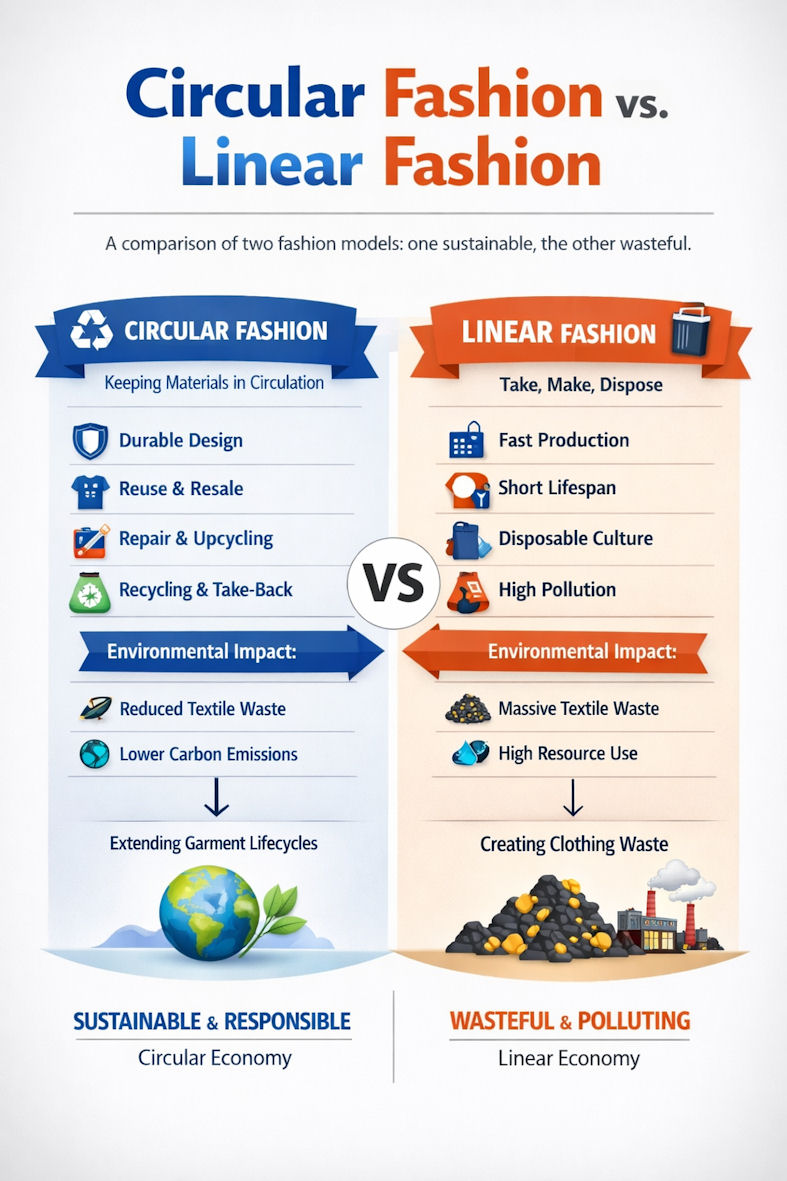
Circular Fashion is where garments and materials stay in circulation for as long as possible. Rather than just wearing an outfit once, you re-wear it to get full use out of it. If an item rips, you repair it. Instead of throwing an item away when you’re finished with it, you resell it or give it to someone else to re-wear. If no-one wants the item, you revamp or upcycle it into a new garment. Or repurpose it into something else entirely. And only when you’ve made all possible use of it, at the very, very end, when you’ve done everything you can with it, do you recycle it. That way, it still stays in the loop, and becomes part of a virtuous circle.
This contrasts with the throwaway culture of recent decades – a linear economy. Linear fashion is where a manufacturer extracts resources, produces something, sells as much of it to you as they can, you use it, then throw it away. Big business has encouraged this linear process of ‘take, make and dispose’ because their only goal is to make a lot of money. Their focus on other values is limited.
Why does Circular Fashion matter?
The number of clothes we throw away is increasing. In late 2022, British Wool found that, on average, interviewees throw away 72 items of clothing (over 3kg) per year. 63% of respondents admitted to chucking clothes away which they could either have mended or taken to a charity shop.
According to the 2025 research by Censuswide, that The National Lottery Community Fund commissioned, UK adults throw away 1.4 billion items (336,000 tonnes) of clothing each year. The average disposal rate per person is worse in Belgium, Holland and Italy, but the UK is close behind. We’re one of the bad boys at the top.
On a global scale, Earth.org estimates that we produce 100 billion garments each year, of which 92 million tonnes ends up in landfills. The rise in online shopping, and fast fashion in particular, generates a lot of that waste. Most items consumers return to retailers end up in landfills. It costs more to put returns back into stock than it does to bin them. And 15% of fabric manufacturers use to make garments ends up as waste on the cutting room floor.
A lot of textile waste goes to charity shops. Of the clothes that we donate to charity shops, only 10 to 30% is worth selling. Charities are able to earn a small amount by selling to resellers and recyclers, but resellers overseas buy 70% of it, usually for poorer countries. And most of it, because it’s such poor quality, gets thrown away. This is why we’ve got big textile mountains in places like Atacama Desert, Chile, that you can see from space. The world dumps over 39,000 tons of discarded clothing there each year.
Why is landfilling clothes such a bad idea?
Most clothes are made of synthetic fibres, such as polyester, that take about 200 years to break down. When they do degrade, chemicals, dyes and bleaches leach into the environment, harming those who live there. Burning the clothes helps to reduce the volume of waste, but the result is toxic air pollution.
How can Circular Fashion avert the throwaway crisis?
A major foundation of the circular fashion model is that we value our clothes, no matter what state they are in. And we want to keep that value at its optimum for as long as possible.
People who value their clothes seek out higher quality garments that last longer and they can wear often. When clothes need mending, we repair them or take them to someone else who can, for example, a repair cafe. Because high quality clothes hold onto their value, we can easily resell them at a good price. When they are beyond repair, we can cut them up and upcycle them into new garments or for new purposes. And when their useful life is finally over, we choose to recycle them so that their threads can return into the loop to make new garments.
A linear model is driven by business and focuses on profit, so they do not design garments that last or that we can easily repair. Hence we can only wear them a few times before we need to dispose of them. Often the fabrics are cheap, polyester blends that are not easy to separate and recycle.
Conclusion
Circular fashion is a sustainable, regenerative system that reduces textile waste. The materials are usually of higher quality and have a less negative impact on the environment.
Other benefits of Circular Fashion:
- makers generally tend to value resources, such as the environment and who makes their clothes
- the process requires a degree of thought and effort, so makers tend to be more resourceful, creative, caring, resilient and committed
- those involved tend to be more collaborative and work for the betterment of the common good


