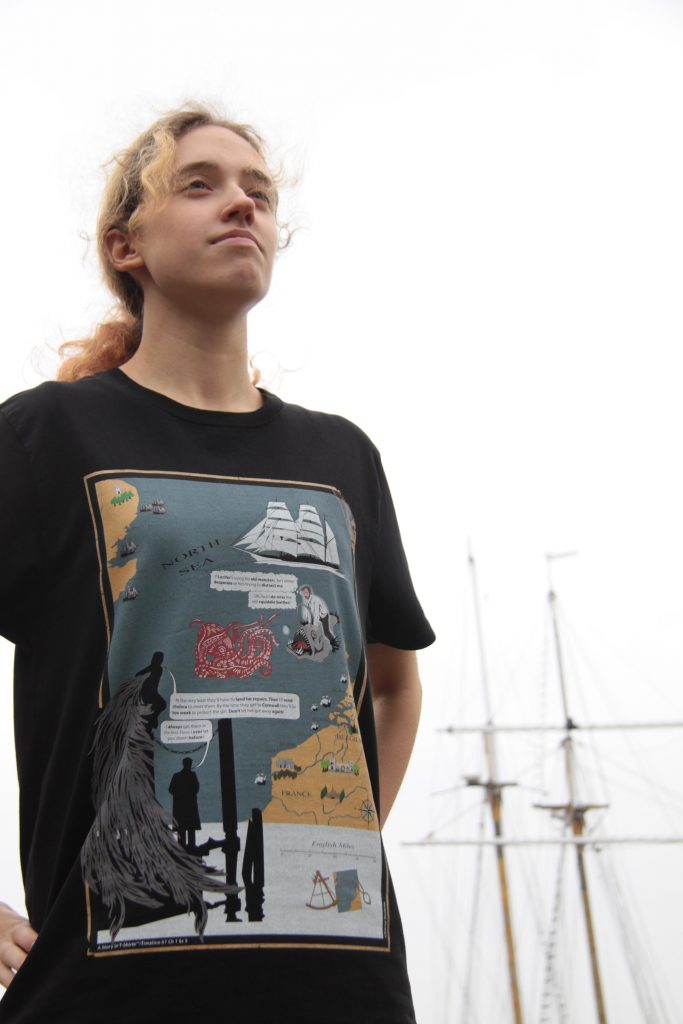
Our Sea Monster Project celebrates sea monsters. It also supports projects tackling plastic and sewage in our oceans and waterways.
We donate 50% of profits from our Sea Monster products to these projects. The charities we support raise awareness of the issues and help to clean plastic and sewage from our seas and rivers. These charities include Surfers Against Sewage and Cornwall Wildlife Trust.
Charities and Projects we support cleaning plastic and sewage from our waterways
-

Cornwall Wildlife Trust
Cornwall Wildlife Trust protects and nurtures Cornwall’s wildlife and raises awareness of plastic and sewage pollution in our waterways.
-

Surfers Against Sewage
Surfers Against Sewage provide a live sewage map and run regular campaigns against sewage and plastic pollution, as well as beach cleans.
Plastic pollution facts and stats
Approximately 8 million pieces of plastic pollution find their way into our oceans every single day (OSPAR, 2009)
12 million tonnes of plastic pour into the ocean every year (Eunomia, 2016)
Scientists have discovered microplastics embedded deep in the Arctic ice (Kelly et al., 2020)
80% of all marine debris studied is consistently plastic (IUCN, 2020)
Around 5.25 trillion macro and microplastic pieces float around in the open ocean, weighing up to 269,000 tonnes (Eriksen, 2014)
Marine plastic pollution kills approximately 100,000 marine mammals and turtles and 1 million sea birds every year (UK Government, 2018)
Approx 5,000 items of marine plastic pollution wash up on each mile of beach in the UK (Marine Conservation Society, 2016)
Feedstock from fossil oil and gas produces 90% of all plastic (Plastic Atlas, 2019)
Producing one tonne of plastic generates up to 2.5 tonnes of carbon dioxide (Material Economics, 2018)
Plastic production is forecast to grow by 60% by 2030 and to treble by 2050 (Center for International Environmental Law, 2019)
We recycle less than a third of all plastic in the UK (PlasticsEurope, 2020)
UK Sewage pollution facts and stats
In 2024, Water Companies reported there were 592,478 discharges of untreated sewage. Surfers Against Sewage (SAS) estimate the real figure to be nearer 1 million. That’s the equivalent of pure sewage pouring into our waters every minute – or every 30 seconds, if SAS estimates are correct.
What impact has this had on our health?
Anyone visiting their local beach, rivers and lakes are exposed to a mixture of untreated human waste, drug-resistant bacteria, ‘forever chemicals’ linked to cancers and organ damage, microplastics and heavy metals. This exposure can produce conditions ranging from sore throats and upset stomachs to serious illnesses like gastroenteritis, hepatitis and E. coli. According to the European Centre for Environment and Human Health, people who swim or bodyboard in UK waters regularly are three times more likely to have antibiotic resistant E. coli in their guts.
In 2025, SAS received 1,502 reports of sickness. These illnesses lost the country 2,952 sick days and nearly half a million pounds in lost productivity. As most cases go unreported, the actual figures are likely to be much higher.
What impact does sewage pollution have on the environment?
Sewage devastates entire ecosystems. It chokes vital marine habitats like seagrass meadows and kelp forests, natural carbon sinks that absorb carbon and help fight climate change. Sewage also disrupts delicate food chains and reduces biodiversity. Sewage feeds harmful algae blooms that drastically reduce oxygen levels, leaving ‘dead zones’ uninhabitable by fish and other marine life. In the longer term, this means that our seas, lakes and rivers are unable to support marine life or recover from environmental shocks.
Why are our waters so polluted?
Lack of accountability
The government privatised water companies nearly 40 years ago, in 1989. Since that time, they have been regularly taken to court and fined for illegal sewage discharges but many are not paying those fines. They are not only ignoring appeals to reduce sewage discharges, they are increasing those discharges at an alarming rate.
Dividends and debt over providing service
Regulators and government bodies have spent the last few decades advising water companies to invest in improving our sewage treatment system. Instead, water companies paid out £74.2 billion in dividends to shareholders. They matched these payments with £69.2 billion in debt. This is a high risk strategy for any company. These dividends become illegal if the payment causes the company to become insolvent or if they are made while the company cannot pay its debts in full. Regulatory bodies like Ofwat and the Environment Agency have not stopped these payments. Rather they have even approved payouts in some cases.
Water bills are set to rise by at least 36% over the next 5 years. Water companies claim this is to fund vital upgrades and maintenance to the sewage system. However, they have been claiming this for some time. Instead they have been paying out big salaries to their bosses and big dividend payouts to shareholders, many of which are based overseas. SAS have calculated that 35p out of every £1 of the average customer’s water bill goes towards shareholder dividends or financing debt. If Water Comanies do not carry out the promised upgrades and maintenance, we’ll risk getting sicker when we swim, surf or paddle.
Inadequate monitoring
Lack of transparency and comprehensive monitoring mean actual sewage discharge figures are unknown. Water Company figures have been significantly lower than those by independent monitors. At best, the equipment and process water companies use for monitoring is faulty and out of date. At worst, those in charge are choosing to mislead regulators and the public.
Latest Sea Monster News
-

Sea Monster T-Shirts
Sea monster t shirts – there be kraken and other map monsters in the sea but there be an even worse scourge – plastic.
-

World Maritime Day
World Maritime Day takes place 25 September 2025. It’s a day to remember and raise awareness of life on and in the ocean.
-

5 T-Shirts cleaning plastic from the oceans
T-Shirts cleaning plastic from the oceans – a guide to the best brands making t-shirts that support ocean conservation
-

Plastic Free July
Plastic Free July – together, we can create a cleaner, more sustainable world – one plastic free step at a time.
Sea Monster Products helping to clean up plastic and sewage
-

Octopus t-shirt | Kraken t-shirt
£30.00 -

Ladies Octopus t-shirt | Kraken t-shirt
£30.00 -

Ghost Kraken t-shirt | Grey Octopus t-shirt
£30.00 -

Black Octopus on white t-shirt
£30.00 -

Kraken Tall Ship t-shirt – ocean blue
£30.00 -

Kraken Tall Ship t-shirt – black
£30.00 -

Kraken Tall Ship t-shirt white
£30.00 -

Timeline 67 Sea Monsters and Tall Ships t-shirt
£30.00 -

Octopus Bag | Kraken Bag
£20.00 -

Sea Monster Project tote bag
£20.00 -

Sea Monster Project Coaster – aquamarine
£4.50 -

Sea Monster Project Coaster – turquoise
£4.50 -

Angler Fish Coaster
£4.50 -

Red Octopus Coaster | Kraken Coaster
£4.50 -
Ladies Kraken Tall Ship tshirt black – sample
Original price was: £30.00.£15.00Current price is: £15.00. -
Ladies Angler fish tshirt grey
Original price was: £30.00.£25.00Current price is: £25.00. -
Kraken Tall Ship t-shirt denim blue – misprints
Original price was: £30.00.£15.00Current price is: £15.00. -
Timeline 67 North Sea Map Sample TShirt
Original price was: £100.00.£65.00Current price is: £65.00. -

Ladies Kraken Tall Ship tshirt white
£30.00 -

Ladies Kraken Tall Ship t-shirt black rolled sleeves
£30.00 -

Sea Monster Project t-shirt – aquamarine
£30.00 -

Sea Monster Project t-shirt turquoise
£30.00 -

Octopus | Kraken black t-shirt
£30.00 -

Angler fish t-shirt
£30.00 -

Squiddie the kraken postcard on black
£1.50 -

Squiddie the Kraken postcard
£1.50 -

Set of 8 postcards
£10.00 -

North Sea Map Postcard
£1.50 -

Set of 10 Timeline 67 Chapter 1 stickers
£28.00 -

Squiddie sticker
£2.50 -

Timeline 67 North Sea Map sticker
£3.50 -

Timeline 67 Chapter 1 Scene 5 Gallery Art Print
£75.00 -

Sea Monster Project mug – aquamarine
£15.00 -

Sea Monster Project mug – turquiose
£15.00 -

Cornwall Secret and Hidden
£12.99